Enterprise Fraud Detection Platform
The Fraud You Can't See Is the Fraud That Will Cost You the Most
The only fraud detection platform that identifies novel attack patterns, coordinated fraud rings, and synthetic identity schemes — without rules, without labeled data, before a single loss occurs.
Trusted by leading banks, fintechs, insurance companies, and credit unions worldwide
Rules catch known fraud. Supervised ML catches variations of known fraud. Neither can see what's never happened before — and that's exactly where your biggest losses are hiding.
DataVisor's unsupervised machine learning analyzes billions of events in real time to detect novel fraud patterns with no historical labels required. No rules to write. No training data to curate. Just fraud, caught before it costs you.

Free Download
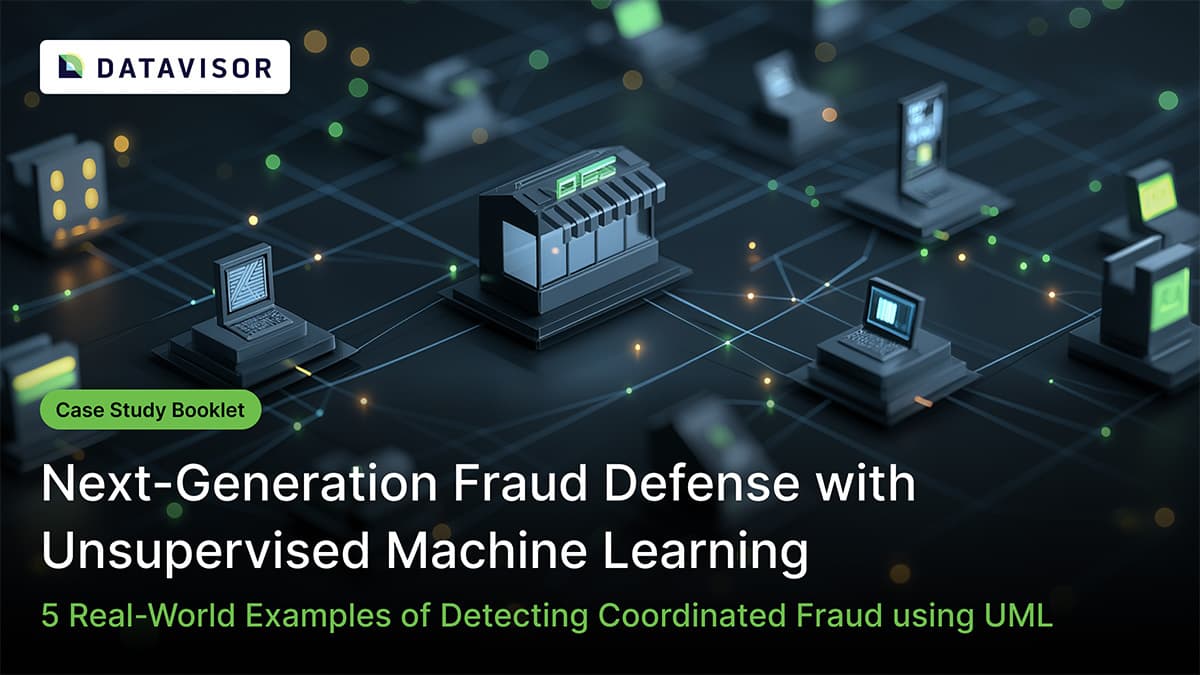
Get the 5 UML Case Studies
See how 5 financial institutions stopped fraud they couldn't see before — free download, no sales call required.
Your Fraud Team Is Working Harder Than Ever — and Still Falling Behind
You've invested in rules. You've layered on supervised machine learning models. Your team writes new detection logic every time a novel attack slips through.
And yet:
- Fraud losses keep climbing quarter over quarter
- New attack vectors appear faster than your team can build rules to catch them
- False positives are burying your investigators in noise — and real fraud slips through the cracks
- Every board meeting, you're explaining why the last breach wasn't caught sooner
The problem isn't your team. The problem is the fundamental approach.
Rules-based systems are reactive by definition — they can only catch what you've already seen. Supervised ML is better, but it still needs labeled training data. That means it learns from past fraud. It cannot detect coordinated attacks, synthetic identity rings, or novel schemes that have no historical precedent.
Your current tools are fighting today's fraud with yesterday's playbook.
What If Your Platform Could Catch Fraud It Has Never Seen Before?
This is the fundamental difference with unsupervised machine learning.
Traditional Approach
“Does this transaction look like fraud we've seen before?”
Dependent on historical labels. Learns only from past fraud. Blind to novel schemes, synthetic identity rings, and coordinated attacks.
DataVisor UML
“Does this pattern of behavior look like it belongs — or is something anomalous happening across thousands of events right now?”
No labels required. Analyzes event relationships in real time. Detects fraud before a single loss occurs — including attacks that have never been seen before.
Detects Unknown Attack Patterns
No labels. No training data from past fraud. UML identifies anomalous behavior by analyzing event relationships at massive scale — catching attacks that have literally never been seen before.
Catches Coordinated Fraud Rings
Individual transactions may look legitimate. UML connects the dots across thousands of seemingly unrelated events to expose rings operating in concert — the kind of coordinated fraud that passes right through rules and supervised models.
Adapts in Real Time Without Manual Tuning
No rule-writing. No model retraining. As attack patterns evolve, UML continuously recalibrates — so your defenses evolve with the threat landscape, not months behind it.
Proven at Enterprise Scale — in Production, Not in Theory
DataVisor runs in live production environments processing some of the highest transaction volumes in financial services.
“DataVisor's ability to give responses in milliseconds has helped us stop bad actor activity almost immediately.”
Robert Rix
Risk Manager, Trust and Payments · Taskrabbit
“Partnering with DataVisor has enabled us to create a centralized intelligence platform that has greatly enhanced our fraud detection capabilities and operational efficiency, allowing us to focus more on our members' needs.”
Doug Nahas
COO · NASA Federal Credit Union
“DataVisor has demonstrated an unwavering commitment to our enterprise success by seamlessly integrating their risk detection scores into our online decisioning.”
Trusted by the companies fighting fraud at the front lines
Not All “AI Fraud Detection” Is the Same — Here's What Actually Matters
The market is flooded with platforms claiming AI-powered fraud detection. But the approach behind the AI determines whether you catch novel threats — or just variations of old ones.
Rules-Based Systems
You define the rules. The system follows them. If fraud doesn't match an existing rule, it passes through undetected. Every new attack requires manual rule creation. False positive rates are high because rules are blunt instruments.
Limitation
Can only catch exactly what you've already programmed.
Supervised Machine Learning
Models are trained on labeled datasets of known fraud. Better than rules at catching variations, but fundamentally constrained by the same limitation: they learn from the past. They cannot detect fraud that hasn't occurred before. They require constant retraining as attack patterns shift.
Limitation
If the fraud is truly new, supervised ML is blind to it.
Unsupervised Machine Learning (DataVisor)
No labels required. No historical fraud data needed. UML analyzes the full event stream in real time, detecting anomalous patterns and coordinated behaviors that have never been seen before. It's a fundamentally different approach — not an incremental improvement.
Advantage
Catches the fraud that every other approach misses.
The question isn't whether AI is part of your fraud stack. It's which kind of AI — and whether it can actually see what's coming next.
See UML in Action — Real Results from Real Financial Institutions
Five organizations. Five different fraud challenges. One approach that caught what their existing tools couldn't.
- How a fintech stopped a coordinated fraud ring operating across 3,000+ accounts
- How a credit union reduced false positives by 60% while catching more real fraud
- How a payments platform achieved millisecond-level detection at 15,000+ QPS
- Real metrics: detection rates, false positive reduction, time to deployment

Free Instant Download
One email. No sales call, no 12-email nurture sequence.
Built for Enterprise Reality — Not Just Enterprise PowerPoints
How long does deployment take?
DataVisor deploys in weeks, not quarters. The platform integrates via flexible APIs and supports SaaS deployment — no on-premise hardware, no 18-month implementation timelines.
“DataVisor enables us to deploy strategies in just 15 minutes.”
Maxim Spivakovsky
Sr. Director, Global Payments Risk Management · Galileo
Will it integrate with our existing stack?
DataVisor is designed to augment, not replace. It layers into your existing fraud infrastructure via REST APIs and supports real-time and batch processing. The platform works alongside your current rules engine and supervised models — adding the UML detection layer that catches what they miss.
“DataVisor's feature store and their data ingestion platform are second to none.”
Peter Senchenkov
Head of Platform Strategy · One Financial
What about false positives?
Legacy systems generate noise. UML generates signal. By analyzing event relationships rather than individual transactions against static thresholds, DataVisor dramatically reduces false positives — meaning your investigators spend their time on real threats, not phantom alerts.
The Fraud You Haven't Seen Yet Is Already in Motion
Right now, novel fraud patterns are moving through financial systems — patterns that rules can't catch, supervised ML can't learn from, and your investigators can't see.
Unsupervised machine learning was built for exactly this moment. See how five financial institutions used DataVisor's UML to catch fraud that their existing tools missed — and what that meant for their bottom line.
Instant access. Just your work email. See the results in under 5 minutes.
© 2026 DataVisor, Inc. All rights reserved. · Privacy Policy